
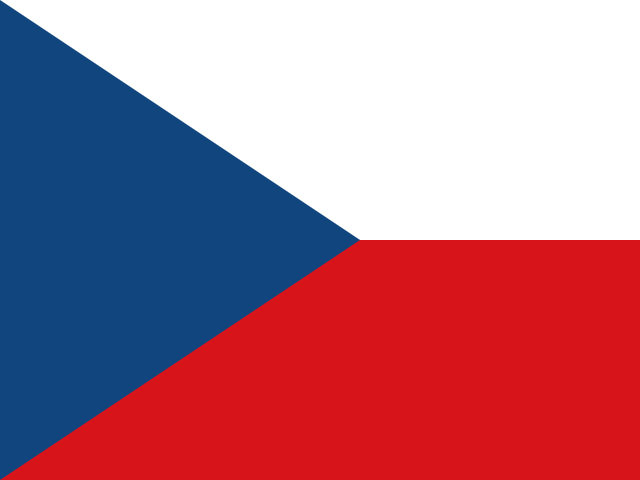
Vodafone's two visitor routes
Vodafone Czech Republic publishes a physical Data SIM for Visitors and a separate Tourist SIM. At the time of checking, its English visitor page listed the Data SIM at 499 Czech crowns, including 20 GB for the first month and 100 crowns of extra credit. It explains that 10 GB of that first-month allowance is a one-time bonus; the recurring bundle is 10 GB and renews after 30 days at the published monthly charge if enough credit remains. The Tourist SIM was listed at 349 crowns for one week of unlimited data. These are operator offers, so check live stock, price and terms before travel.
The same page lists top-up through Vodafone shops, selected cash machines and retail terminals. Its top-up section names a Czech-issued card for My Vodafone, while a later FAQ says Czech- or EU-issued cards with two-factor authentication are accepted. Because those descriptions differ, confirm whether your particular card will work before depending on an online refill. The initial extra credit is separate from the data bundle, and the printed expiry and renewal terms matter if your trip continues beyond the first week or month.
Vodafone's traveller page also offers a subscription eSIM through the My Vodafone+ app. It says the customer chooses a monthly plan, enters payment details and activates the prepared eSIM in the app, with regular payment cancellable. This is a different product from the prepaid physical visitor cards. The eSIM page says its plans include data within the Czech Republic and a separate allowance in the rest of the EU. Compare the actual monthly price, any speed limit and the EU allowance at checkout rather than transferring assumptions from the Tourist SIM.
Prepare the phone before paying
An app-based eSIM purchase requires a compatible, unlocked handset and an internet connection during setup. Vodafone's traveller page says it prepares the eSIM after payment-card registration, then activates it from My Vodafone+. Download the app and confirm device support while still connected before departure. If keeping a home SIM for bank texts, decide which line will handle data and outgoing calls once in the Czech Republic. A phone with two active lines can still charge for data on the wrong one if automatic switching or roaming is left on.
A physical visitor SIM avoids the eSIM compatibility question but must fit the phone. Confirm the chosen card's activation and renewal conditions at the point of sale. The Vodafone page says a Data SIM for Visitors contains a preactivated first-month bundle, yet the subsequent bundle renews only if sufficient credit is present. A visitor who assumes the original 20 GB recurs will misjudge both data and cost. Keep the initial packaging or account details so support can identify the product later.
What the regulator's maps can show
The Czech Telecommunication Office, CTU, links to an interactive map of calculated 4G and 5G coverage from operating base stations. It also describes layers for the 700, 800, 1800, 2100 and 2600 MHz bands and tables by region, district and municipality. These are calculated coverage data, not a promise that an individual phone will receive a chosen speed inside a hotel, in a tunnel or on a moving train. Inspect the settlements and route segments that matter to you, especially if leaving Prague for smaller towns.
CTU has separately measured mobile signals on motorways and transit railway corridors. In its 2025 announcement it said the operators met the development criteria linked to the frequency auctions, while also discussing further improvements such as repeaters and train windows that transmit signal better. That finding does not mean every carriage, seat or tunnel has continuous mobile data. A route through Brno, Plzeň or a rural border area should be checked on the coverage map and prepared with offline tickets and directions.
The operator shown on the screen can matter when roaming. A home plan may connect to one Czech network under its roaming agreement, while a local card uses its issuing network. Compare the available map layer with the network your actual plan is likely to use. Check the handset’s supported bands with its maker.
From Prague Airport to the city
Václav Havel Airport Prague says its free Wi-Fi network is called Prague Airport WiFi Free. It can be used to open the Vodafone app, retrieve an eSIM confirmation or check onward travel. Save the activation information before flying as a fallback, and test mobile data away from Wi-Fi before leaving the terminal. The airport recommends trolleybus 59 from either main terminal to Veleslavín, followed by metro Line A for the city centre. Its bus page says passengers need a ticket before boarding.
Prague Integrated Transport's PID Lítačka app has a timing rule that matters when relying on data at a stop: tickets become valid one minute after activation. PID warns that entering a vehicle or the paid metro area during that minute can lead to a penalty. Its guide says an internet connection is needed to pay for and activate the ticket, although an activated ticket remains valid without a connection. Open the app, activate in time and confirm the countdown before walking through a metro entrance.
The PID app also allows a ticket to be purchased in advance and activated manually later. This is useful if you want to buy while on airport Wi-Fi but decide the precise journey after landing. Make sure the planned zone and duration match the trolleybus and metro trip you will take. The connection from Prague Airport is a city transport journey, not a direct railway platform at the terminal.
Rail app use and cross-border data
Czech Railways' Můj vlak app provides journey search, ticket purchase, platform information and delay notifications. Its page says tickets can be bought without registering an account and paid for with a card or supported mobile wallets. It also says journey information can be available offline, whereas ticket payment requires a connection. Buy a ticket while signal is dependable, then check that the QR code has appeared in the app before boarding. Do not rely on an email being accessible later if the phone's data line changes.
The Czech Republic is in the EU roaming area. The European Commission says a qualifying EU or EEA home contract normally provides domestic-rate roaming for periodic travel, subject to fair-use conditions. Check your home provider's data allowance first; a visitor who already has enough EU data may have no need for a Czech SIM. A trip continuing to Austria, Slovakia, Poland or Germany stays within the EU framework, but a Vodafone visitor product and a Vodafone traveller eSIM may have different cross-border benefits.
Keep an emergency calling route
The Czech Ministry of the Interior lists 112 as the common European emergency number. It also lists 150 for the fire service, 155 for ambulance and 158 for police. Save the accommodation address and the name of a nearby stop or landmark before a day outside Prague. A data-only eSIM's ability to browse or message does not establish that it can make a voice emergency call. Keep a working voice-capable line or another reliable calling route and know the phone's emergency controls.
Before a long motorway or train leg, make sure the route, ticket and accommodation details remain visible without fresh mobile data. CTU's transport measurement shows that coverage is actively monitored, but it cannot certify an uninterrupted connection for every handset and carriage. Check the remaining allowance and whether the correct line is selected for data. If the plan is Vodafone's visitor prepaid card, note the renewal date and whether enough credit is present; if it is the app-based eSIM, review its recurring payment control.
Networks our Czechia plans use
These are the operators named on our plans for Czechia, taken from the plan data, so the list follows the catalogue.
- O25G
- O2 - CZ5G
- O2 Czech Republic5G
- T-Mobile5G
- Vodafone5G
- Vodafone Czech Republic a.s.4G